Showing posts with label Movies. Show all posts

Tuesday, 1 September 2015

14 stories that inspired Ray


      I bought this book at the Kolkata Airport last time I was returning from India. Edited and translated by Bhaskar Chattopadhyay, this book comprises fourteen stories by various authors that Ray transformed into great cinema, some of which are world renowned for their universal and timeless themes.


"Devi" or "The Goddess"written by Prabhat Kumar Mukhopadhyay as "Devi"


"Kapurush" or "The Coward" written by Premendra Mitra as "Kapurush"


"Agantuk" or "The Guest" written by Satyajit Ray as "Athithi"


"Goopy gyne Bagha Byne" written by Upendrakishore Ray Chowdhury


"Teen Kanya" , that is a triptych comprising of three short stories, all written by Tagore:


"The Postmaster"


"Monihara"


"Samapti"


" Mahapurush" written by Rajshekhar Basu as " Birinchi Baba"


"Jalsaghar" or "The Music Room" written by Tarashankar Bandopadhyaya as "Jalsaghar"


" Mahanagar" written by Narendranath Mitra as "Abotaranika"


"Parash Pathar" or "The Philosopher' Stone" written by Rajshekhar Basu


"Sadgati" written by Munshi Premchand


"Shatranj ke Khiladi" written by Munshi Premchand


"Pikoor Diary " written by Satyajit Ray


   I think this is a must read for literary as well as cinema fans, because firstly, it is a sheer joy to behold a motion picture that is based on a book or novel that one has read time and again, with it's own private visions in a reader's mind. Secondly, it provides Ray fans with a glimpse of the great director's interpretation and rendition of such classic stories that he translated to celluloid. The themes that he chose range from the joyous to noir, mundane to profound, dramatic to slice-of-life, and all of them resonate with a global audience.

Friday, 24 July 2015

On the joys of reading and rereading the classics, and why there are so many multiple screen adaptations

           The past few weeks have been full of reading. I stumbled across Donna Tart's excellent 1992 book "A Secret History" when I was checking the literary references in the movie, " Dead Poet's Society". Hailed as a modern classic, the book is a first person narrative of the macabre experiences of a Californian fresher, who joins an elite university in Vermont, and befriends a clique of students who study Greek literature under a very enigmatic professor. Pretty soon, the academic idyll is shattered with the death of one of these friends, and the ensuing repercussions is what constitutes the bulk of the narrative.
In fact I was so besotted with the reviews and references of this book, that I actually went to Popular to buy the book when I could't get it online. Alas! After I combed through most of the shelves, trying to look beyond the " Fifty Shades of Grey" and other modern bestsellers piled up in eye-grabbing patterns, it was time to ask my brother to send me an e book. The moment he sent that, all I did, apart from lab work, was to read and savor the book.


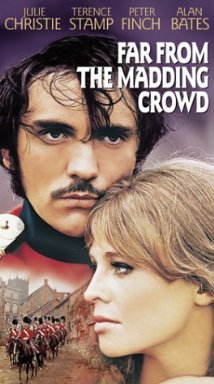
 Around that time, Thomas Vinterberg's adaptation of the Thomas Hardy classic " Far from the Madding Crowd" released. There is an interesting memory associated with this book. I had won it in a creative writing competition when I was an undergraduate, but had not read it until recently. There are two versions already adapted for the big screen, one in 1967 (starring Julie Christie) and another in 1998.


Which sort of made me think why the classics have the power to draw us back to them again and again, and how each time, they speak new things, altering our perception of them, and the associated memories while reading them. I have not seen the previous two movies, but the 2015 one starring Carey Mulligan as the intrepid Bathsheba Everdeen and the extremely handsome Matthias Schoenaerts as Gabriel Oak left me spellbound. 
And that set the tone for Thomas Hardy, and I went ahead and watched " Jude" based on his other novel, " Jude, the Obscure" as well as " The Return of the Native", and was left transfixed by the modernity of the respective heroines Sue Bridehead and Eustacia Vye. D H Lawrence revered Hardy and was inspired by him, and probably that's why both these authors' predominant themes revolved around class issues, repression of freedom and sexuality, and men and women suffering due to these shackles of society.


                        I know Jane Austen is a universal favorite, but I'm more of a Bronte' sisters' fan, especially "Wuthering Heights" and " Jane Eyre". And the fact that there are so many screen and theatre adaptations spanning decades is a testament to the greatness, timelessness, universality and popularity of theses classics. Jane Eyre has close to 10 movie adaptations, my favorite being the 1996 version directed by Franco Zeffirelli and starring William Hurt and Charlotte Gainsbourg as Jane and Mr Rochester. The more recent 2011 version directed by Cary Fukunaga starring Mia Wasikowska and Michael Fassbender is good too. Its the same with " Wuthering Heights" too, with close to 10 adapations for the big screen as well as TV series over the course of five decades.
        The surprising aspect is that each adaptation of these classic tales, as much as each reading or re-reading of the same brings out something new each time. Little details spring to notice, and certain issues become more noteworthy for their everlasting influence.

                          I think we reread and love to revisit the classics for the simple reason put forth by Italo Calvino, that " A classic is a book that has never finished saying what it has to say". Most people are initiated to read the classics at a young age (my assumption), sometimes by enthusiastic adults or as part of the school curriculum, or as abridged books, and hence it is but natural that those books become an inherent part of childhood memories, some still fresh in the mind, some tucked away in the hidden folds of memory. The same book, when read as an adult conjures up the memories of childhood, at the same time, in the light of maturity that comes with age, highlights some other aspects of the book. Moods too have so much to do with how a book is perceived.
             While this is applicable to most books, classics have their own niche in this scheme of things. They are timeless, for one. Pick any Shakespearean tragedy or comedy, and extrapolate that in the contemporary travails of society or life, you will find instant resonance. Pick any heroine from a Thomas Hardy novel, and instantly, a likeness with your personal struggles as a woman in today's world will appear. And think about when these were written. The sixteenth century. Or 1860. We talk about sexuality and openness today. Read Lady Chatterley's Lover, written by the brilliant D H Lawrence in 1928, and feel the passion of his views on repression of sexuality and class discrimination, and in a snap, you will be able to relate to it, despite a difference of more than 8 decades. Little Women, published in 1880, which I read when I was 11, then at various stages of my life time and again, continues to bewitch me, soothe me, transport and transcend me. Maybe that's why we read them over and over again.

My 10 best classics are:

1) Little Women
2) Lady Chatterley's Lover
3) Great Expectations
4) To Kill a Mockingbird
5) Far from the Madding Crowd
6) Rebecca
7) Gone With The Wind
8) The Thorn Birds
9) Wuthering Heights
10) Jane Eyre

Of course, the list is endless.
Here is a list of 100 best classics from the Guardian.
http://www.theguardian.com/books/2003/oct/12/features.fiction

Saturday, 17 January 2015

Movies seen this week that left an impression

Only Lovers Left Alive


Little Children


The Orgasm Diaries


Boyhood


Enduring Love


Monday, 5 January 2015

Jungle Book.....in theaters October 2015

    Such awesome news! Disney is coming out with a screen adaptation of Rudyard Kipling's "The Jungle Book" in October, 2015!! And look what a smashing ensemble cast has been brought together under the helm of director John Favreau:


Idris Elba as "Shere Khan"


Ben Kingsley as "Bagheera"


Bill Murray as "Baloo"


Scarlett Johanssen as      " Kaa"

Lupita Nyong'o as        "Rakska"


Neel Sethi as " Mowgli"


Christopher Walken as "King Louie"

and Giancarlo Esposito as "Akela"


Can't wait to see one on my childhood's favorite stories come alive on the big screen with such a superb star cast......

Tuesday, 9 December 2014

Alienation and loneliness: thoughts on "Silent City"

      Japan. 
A true paradox. A simmering vista of subways, railway lines, over-crowded trains, somber faced salarymen trudging towards work. Kimonos and Sakura blooms, Kabuki masks and Sumo wrestlers, sushi and sake.A fetishistic society with a unique mix of stringent tradition and obsession with perfection, as well as an uber-modern fixation with Manga and technology. A Janus-faced culture that has the Zen Buddha on one side, and the seedy, tantalizing, neon lit alleys full of bizarre possibilities on the other.
       And precisely for these reasons, an object of desire for those who seek the unconventional, the different, the alien. Believe me, there are those who just wanna live on the fringes of their own societies, and hence look for solace in the sense of utter alienation and awe that other cultures evoke in them. In the very essence of that alienation is the lurking security of acceptance and association. 

And that's what we see in Threes Anna's strikingly visual tale of a young Dutch woman, Rosa, who comes to the ever jostling metropolis that is Tokyo, teeming with people and trains and lives, to learn the exquisite art of filleting fish, only to be overwhelmed by the sheer force of alienation and loneliness that threatens to engulf her, in this "Silent City".  


Her mentor, her "Sensei", is Master Kon, a world famous fish chef who, apart from being a wizard with his knife in filleting a variety of fish, also possesses the magical art of attracting fish to his open hands. Rosa is simply awed by his talents, yet there is something, an intangible wall between her and Master Kon, and the very essence of understanding fish, that bothers her throughout.


At first, she slowly lets the Tokyo rush sink into her.She gets a place of her own, and very tenderly cares for a bonsai plant with just one leaf. She attends classes, where everyone speaks only Japanese, but she is content to just observe and fillet small fish, wishing to get promoted soon to bigger fish and later to really cook fish. In order to sustain herself, she takes up a job as a call girl to entertain the salarymen in a nightclub. Although not very keen on this idea, she at least has a source of income now.

Gradually though, things begin to get fuzzy. She came to Tokyo, leaving behind her comfort zone, to accept and embrace this culture. To understand perfection; to learn it from this demi God of fish. But something seems amiss. Master Kon's standards are high, and his reticent attitude begins to gnaw at her psyche. So much so that she begins to have disturbing visions of herself with fish. She constantly feels under water, at one with the fish, trying to feel under their skin, communicate with them, but failing each time. 


One particular scene that in a way brings together all the elements of  Rosa's utter desperation in this alien city is on a night that she escapes from a customer's house after a rape attempt. Desperate to bury her sorrow in the company of one kindred spirit, she comes across a makeshift cardboard box house that she has seen many times before on the streetside. She opens a flap, enters inside the box, to see a man heating soup on a small stove inside. No words are exchanged, but he offers her a bowl of soup, and for some reason, all the months of despair, the harsh loneliness, the complete absence of human compassion, rather even human companionship....culminate, and she finally emerges happy and content.

In a metaphoric sense, she is now part of the immense sea that is Tokyo, She, who was about to drown in this immense deluge, learns how to swim with the fish.


She goes back to her school, and is able to finally communicate with the fish. She now understands her art. She is finally......the fish under water.


A great movie. Silent City.


P.S. In the same trend, I also simply loved " Ramen Girl"with the late Britanny Murphy ( may she rest in peace) portraying the role of the American who decides to master the art of Ramen noodle making, and after a series of mishaps, finally triumphs.

More stuff on Japan that I intend to write about is on " Lost in Translation", "The Japanese Wife" and Pico Iyer's travelogue cum memoir, "The Lady and the Monk".

Monday, 8 December 2014

A long cherished dream come true: my Cineclub

      It was during my Master's in Hyderbad Central University that I truly discovered a passion for good cinema. The Mass Com department used to organize Film Fests, where they used to screen World Cinema that brought to light human strories from across the globe, and featured movies directed by absolute stalwarts like Martin Scorsese, Stanley Kubrick, Jean- Luc Godard, Roman Polanski, Ingmar Bergman, Akira Kurosawa, Satyajit Ray, Francis Ford Coppola, Alfred Hitchcock and so on and so forth....
      Many a weekend was spent watching back to back screenings of movies from all genres and walks of life. Watching a movie with a select clique of people, assimilating the finer nuances of cinematic techniques, brooding on some great shots.....I was hooked. But alas, the opportunities lasted only for two years, after which I got a little lost in the throes of life.
       A couple of years back, I happened to come across a blog by the very talented and perceptive Jai Arjun Singh, called "JABBERWOCK". I was hooked once again. His many writings on cinema, as well as books and other general topics took me back once more to those long ago spent moments with a group dedicated to the pursuit and appreciation of good cinema. His detailed descriptions and critiques of movies are informative, very well researched, highly dynamic and pertinent to the issue at hand. 
      And just a couple of months back, here in Singapore, my Italian flatmate invited me to a film club run by a clique of expats, from places like Mexico, Britain, Italy and Spain. The movie we saw was an Italian movie called "Il Sorpasso".  I was really glad that finally, I would have some company in a hobby that all this while had been a pretty solo affair. The movie was good, and the discussion we had after the movie was even better. I was happy. But it didn't last long. The next week, the movie had to be cancelled because everyone was so busy, and after that they discontinued altogether due to some issues.
     That's when the thought struck me! Why not get my own projector, and start my own Cineclub with a few select people I know who appreciate good cinema? And just like that, I bought my own Epson EB-W03 projector at the recent SITEX IT fair , and started what I had been wanting for a very long time....our Cineclub.


We screened Rituporno Ghosh and Deepti Naval's " Memories in March" last week, and it was liked by everyone. We will be screening the very distinctly different "3Iron", Kim Ki Duk's Korean drama this week. I'm glad I did this......so glad!

Thursday, 21 August 2014

Two soulful dreamlike songs that could pass off as lullabies

Arijit Singh's " Saawali si raat ho" from the movie " Barfi"


Shalmali Kholgade's "Kap, kap kap" from the movie "Prague"


The same song in Czech sung by Daniella Fotju


Melodious, soothing, ethereal.....

Wednesday, 20 August 2014

Lessons in Forgetting

       I just began reading " Lessons in Forgetting" by Anita Nair. It has already been adapted into a critically acclaimed movie released in 2011. 
       I was watching bits of the promos and trailers on you tube when I chanced upon the title credits of the movie that is done in sand art. It is in a way, a visual retelling of the actual tale, as it depicts how carefully a single father brings up his daughter, only to let her go when she finds her own wings and her own ways. Sadly, the world is not such a safe place, and soon, the free spirited daughter gets caught in a vicious web, and despite everything, the father is simply unable to extricate her from the quagmire.


Tuesday, 12 August 2014

Carpe diem: Seize the day; thoughts on Robin Willaims

           I think at a time when the world is simultaneously being plagued by grave problems; a war in Israel, an Ebola viral outbreak in Africa, blowed up passenger flights and airplanes gone missing over regions in strife, and a so called "Islamic State"  that has taken religious fundamentalism to an altogether new realm , I wonder what can save the world?
           Hope. Maybe. But surely humor. And then this news of Robbin Williams, one of the best comedians/actors of our times, reported dead, after committing suicide at his residence. He had apparently been dealing with substance abuse and depression for a long time.But when I remember him, as the funny guy with a big mouth and long nose and an insanely sunny and hopeful disposition, I simply cannot reconcile this fact to his screen persona. People like Williams are supposed be the ones that make countless people laugh and cry at the same time. No wonder, the world is shocked at this news, and millions of fans mourn for a man who embodied fun , humor and joy on the silver screen.
                   He was one of those really nice actors who could come up with just about anything at the spur of the moment and draw you in and make you laugh, and as I said earlier, cry, with the same intensity. Although he has starred in many movies, the closest to my heart are :


The Bicentennial Man:


The movie strikes a chord, especially in the current context as more of us are succumbing to a "robotic" lifestyle, whereas this guy here was built a robot, but gradually imbued human talents and values and was accorded the status of a "human" on his death bed.


Dead Poet's Society:


Perhaps my favorite movie of his. Portraying the role of an unconventional English teacher, John Keating, at a boarding school for adolescent boys in this coming-of-age tale, he will best be remembered for his inspiring teachings, and his "Seize the day, Carpe diem " speech. And of course, as he is expelled from school for his radical methods, the scene where his students entreat him, from Walt Whitman's classic poem, "Oh Captain, my Captain!!"


Takes me back to those days when I saw these movies and marveled at the emotions they could make us go through.


Patch Adams:


Another great movie, with Williams winning the hearts of all his patients as much with his optimism, wit and jokes as his medical expertise. A friend from Turkey said that some Med schools there screen this movie for novice doctors before they really begin to treat patients. Also, it is one of those Robin Williams movies that make you cry and cry for the sheer emotions he evokes. 


Good Will Hunting:

Of course, who can forget the role that finally fetched him the Oscar in a Best Supporting role. His role was that of the school psychiatrist who empathizes and inspires the troubled yet gifted mathematician played by the handsome and talented  Matt Damon.


And finally, Mrs Doubtfire:


No one could've better played the role of the broke, desperate father trying to reconnect to his three children after he divorces his wife,by dressing in drag as the capable nanny, "Mrs Doubtfire". Hilarious, sensitive and pure fun to watch, this was one of those movies that one can watch again and again without ever getting bored. 

We will miss you, Robin Williams. You had so much more to offer. Yet, your legacy will stay on forever, bringing smiles and laughter to all your fans. 

Thursday, 5 June 2014

Duvidha vs Paheli

The first time I saw Paheli ( released in 2005), it was love at first sight. I mean....look at it....Amol Palekar at the helm, my darling Rani...draped in the beautiful, colorful fabrics of Rajasthan, her petite frame looking spectacular in jewelry by Tanishq, and the dapper Shah Rukh Khan, and most importantly, a tale based on folklore; what is not there to love?


When I read about the making of the movie, I came to know that it was adapted from a  play by Vijaya Dan Detha " Bijjli" based on a Rajasthani folk tale. Briefly, the movie describes the dilemma faced by a newly wedded wife (Lachchi),whose "vyapaar" crazy husband leaves her to go off to a distant land the very next day of their marriage. Devastated by the imminent loneliness of the next 5 years of separation, the bride is pleasantly surprised when he returns the next day, claiming to have met a seer on the way who blessed him with a boon that he would be given 5 gold coins daily. But in truth, the person who has come back is in fact, a ghost, who had seen Lachchi when the wedding procession had rested under a banyan tree on which the ghost dwelt. Instantly smitten by the bride's beauty and innocence, the ghost is appalled when he sees her husband return to rest under the same tree, ready to embark on a business trip for the next 5 years, having left his wife alone, and his marriage unconsummated.

Love for the deserted wife and the lure of a chance at changing his destiny propel the ghost to take the form of the husband, and return to his lovely Lachchi, who is simply ecstatic and wonder-struck at his return. But not having the heart to lie to this innocent woman, the ghost confesses to his trickery. Lachchi is crestfallen at the news, and more than that, is struck with the immense dilemma she faces. On one hand, she may choose utter loneliness and the bland feelings of her true husband ;on the other, she may throw caution to the winds, embrace the love of this gentle, loving ghost, thereby salvaging the little chance at getting love and care in her lifetime. Torn between duty and desire, she finally listens to her heart. " Jaane wale ko rok na saki, aane waale ko kaise na rokun?" ( I couln't stop the one who left, how can I resist the one who's come back?")
And that is the real "duvidha" faced by Lachchi.

Shot on location in Rajasthan, the film boasts of wonderful art design, cinematogarphy, and production design. Every shot is almost like a painting, with the backdrop of the havelis and the landscape adding to the magic of the love that the ghost husband and Lachchi share.


As their love grows, we see how deeply fulfilling the ghost's love has been for Lachchi. Eventually, she becomes pregnant, and there is one poignant scene wherein the ghost is paying an ode to Lachchi's womanhood and her upcoming motherhood. " Aurat hone ka tera aisa roop pehle to na dekha".(I haven't seen this facet of your womanhood before". To which she lovingly, tearfully replies, " Bhoot hona, tabhi aise keh rahe ho" ( You say this only because you are a ghost, and not a man).

But dark clouds are just on the horizon. The real husband has begun to miss his wife, and images of her haunt him during moonlit, lonely nights. The feelings are accompanied by the soulful " Dheere jalna...dheere jalna" rendered beautifully by Sonu Nigam, although only Shreya Ghoshal won the National Award as playback singer for the female version of the same song.


So the real husband decides to write to her, only to discover later that there is already a look-alike husband in his house and his wife is pregnant, ready to deliver any moment. He is totally shocked at this revelation, and decides top go back to contest for his right and true identity. Once he arrives is his house, everyone is flabbergasted at this twist of fate. Moreover, not a single person is ready to believe in his side of the story. There is a certain pity that you begin to feel for this husband, who was, in a way, a good person, but spurred by his father's ambitions and demands, had turned into a money minded miser incapable of showing love.

But the "Paheli" ( puzzle) has to be solved, as Lachchi cannot have two husbands. One of them is an impostor for sure.When the real husband, Kishanlal, asks the ghost, who exactly is he, and why has he taken his place in the household, the ghost calmly replies-" Aurat ke man main jo preet hove, vo hun main"
 (" I am the love that dwells in every woman's heart"). What an apt answer!

So all the villagers decide to go to the ruling King so that they get justice at his hands. En route to the palace, they encounter a shepherd, played to the T by Amitabh Bachchan Sir. He intervenes and tells them that why go to the King, when he himself could solve the puzzle. So he asks the two men to do a series of impossible tasks not humanely possible. The ghost, endowed with magical powers performs these tasks easily, even though Lachchi had asked him to refrain from any such displays. The final task that the shepherd lays for them is to enter a goatskin bag that he uses to carry water in the desert. Of course it is a trap, and we see the ghost transforming himself to sand and entering the bag effortlessly. As soon as the ghost enters it, the shepherd caps it and tosses it into the endless desert dunes, and we see the bag with our dear ghost in it, lying there, while the desert sand keeps piling on it, turning it into oblivion.


So, did Lachchi, who by this time has given birth to a daughter, lose the ghost lover forever? You can watch the movie and see for yourself.

On a broader scale, isn't Lachchi's yearning for a more loving, expressive, caring husband who loves her for what she is, every woman's too?

That apart, I recently happened to watch the earlier version of this movie, or you may say the original adaptation of the play, that was directed by the acclaimed Kashmiri director, Mani Kaul Sir. It was called "Duvidha", for which Mani Kaul won the National Award for Best Director in the year 1974, and also the Filmfare Critics Award for Best Film.I do not want to compare the two films as both have their merits.

"Duvidha"( 1973) is more true to it's folklore roots. The cinematography is stark and the outstanding feature of the movie is that rather that dialogues between the protagonists, the story and the internal monologues are narrated by the narrator. That too is pretty minimalist and stark, shorn of any over-the-top gimmicks. Yet, the crude rendition, at first a little hard to connect to, slowly grows on you and you become enamored to Lachchi ( played by the strikingly beautiful Raisa Padamsee) and her plight saddens you. The movie may not be technically so rich in imagery as compared to "Paheli", but shots where Lachchi's face is shown in light and in shadows, reflecting her various moods, are the best parts of the movie. I was mesmerized by the sheer weight of her beauty and what the interplay of light did to that beauty. Have a look:


I mean....just look at her...she's a vision. And the surprising bit is that at the time of filming this movie, Raisa did not know a word of Hindi as she is half- French and nor did she act in any other films after this one.
Well, a true hidden classic that I doubt many people are aware of. But a must watch for those who appreciate the art of stark, simple, elegant storytelling.

Here are the contrasting images of the puppets used in the two movies. I found them so fascinating, I had to put them here.


Also, some behind the scenes snaps of Shah Rukh and Rani with Amol Palekar while filming the movie.